nilam
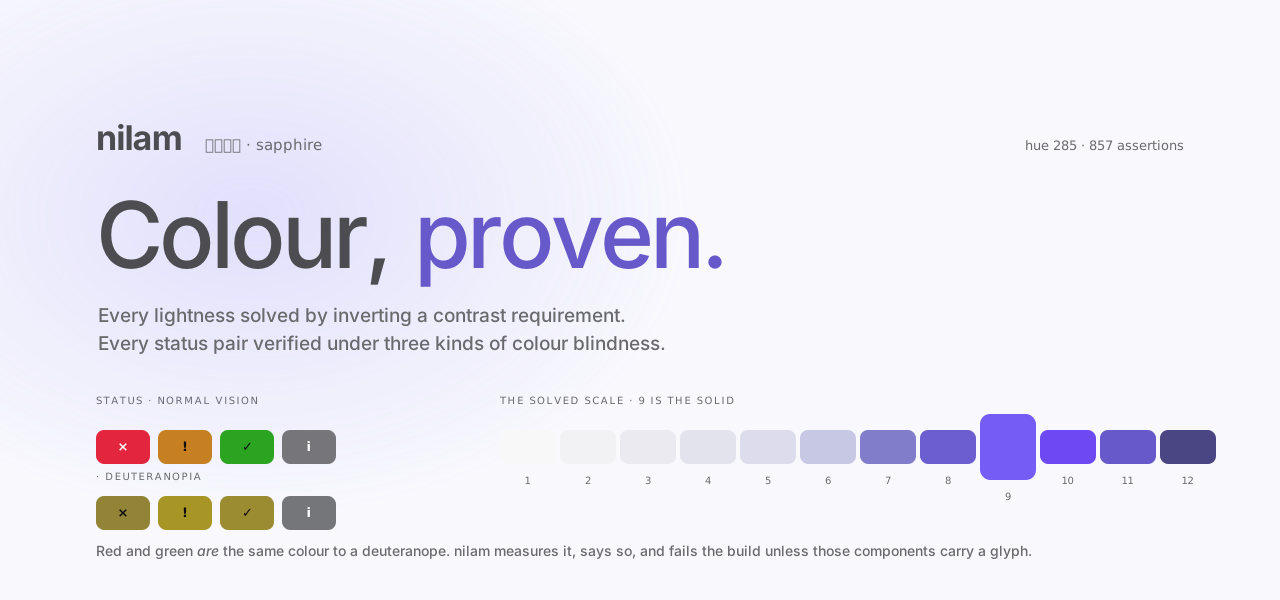
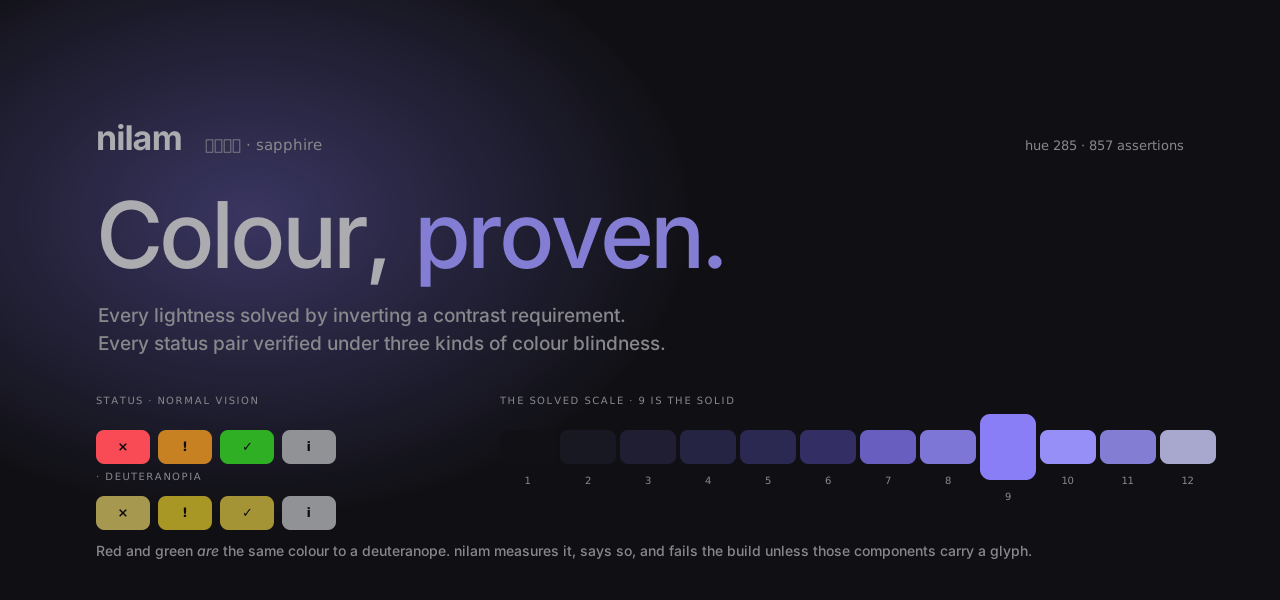
Proven colour. A design system whose palette is solved from contrast requirements rather than picked, and verified under three kinds of colour blindness before it ships.
नीलम — sapphire. The signature is a violet-blue at hue 285.
That is the whole example. One class, no dark: variant:
Those two panels are on this page at the same time, one forced light and one forced dark,
with no token redeclared. That is light-dark()
doing the work.
The button is a dark violet with white text on the light panel and a glowing light violet
with dark text on the dark one, because step 9 differs by mode and --brand-ink follows
it. See the two brand moments.
What is new
Two things, stated narrowly.
1. Scales are solved, not picked
Every lightness in the palette is found by inverting a contrast requirement. Step 11 is not "a grey that looks about right for body text" — it is the lightness at which text hits 4.5:1 against step 3, computed. The contract is the construction, so a step cannot exist at a value that breaks it.
Hand-tuned scales are unverifiable by construction: nothing fails when a step drifts. Here, something fails. Why solved colour is the argument, including the four times the solver was wrong and what caught it.
2. No assertion shares a premise with the thing it audits
The load-bearing idea here, and it was learned the expensive way.
Every border in an early version was solved against the page and asserted against the page. Step 7 measured exactly 3.05:1 and was declared compliant. On a card — where controls actually live — it was 2.70:1. The code that chose the value and the code that checked it made the same wrong assumption, so nothing disagreed.
Twenty-five defects have been found in this package, and none of them by the assertions that existed at the time. Every one came from running it against a real application, or from someone trying to reproduce a number that had been written down.
So the checks are built to have an independent premise. Borders and text solve against the
worst surface they may sit on, not the easiest. Display-P3 is solved and proven in its own
gamut rather than mapped from sRGB and assumed fine.
test/surfaces.test.mjs
reads the shipped CSS and measures every painted surface against what it actually sits on —
and an unclassified surface is a failure, not a pass, because a check that only tested pairs
it already knew about would be a mirror of the stylesheet.
7,879 numeric assertions and 31 visual baselines, in CI, on every push. Why solved colour has the four times the solver itself was wrong.
The keyboard layer has not been tested with a screen reader
Not NVDA, not JAWS, not VoiceOver, not TalkBack. The ARIA contracts are implemented from the APG; real assistive technology diverges from specification. Where certified AT behaviour is a requirement, pair nilam with React Aria. The full list of boundaries is on Limitations and it is worth reading before you depend on any of this.
Install
Everything:
Or just the parts you want:
@import 'nilam/tokens.css';      /* solved colour, light-dark() */
@import 'nilam/scale.css';       /* type, space, radius, motion, elevation */
@import 'nilam/base.css';        /* element defaults, hue leaks closed */
@import 'nilam/components.css';  /* the .n-* layer */
@import 'nilam/widgets.css';     /* combobox + slider, needs nilam/behaviours */
@import 'nilam/tailwind.css';    /* Tailwind v4 / shadcn bridge */
Zero dependencies, no build step, no runtime. React, Next, Vite, Astro and a bare .html
file consume the identical file.
| I want | Go to |
|---|---|
| The argument, and the failures behind it | Why solved colour |
| The dichromacy assertion, simulated live | Colour blindness |
| Every token, every swatch, theming | Tokens |
| Buttons, dialogs, tables, the lot | Components |
| Arrow keys, typeahead, roving focus | Behaviours |
| Figma, Swift, Kotlin, Style Dictionary | Platform export |
bg-primary painting a proven colour |
Tailwind and shadcn |
| What this does not do | Limitations |
Your own hue
The palette is not a set of values, it is a function. Pass a different hue and everything is re-derived:
import { solvePalette, prove } from 'nilam';

const palette = solvePalette(262);
const { failures } = prove(palette);
if (failures.length) throw new Error(failures.join('\n'));
The prover runs on your hue. If a green that separates from it under tritanopia does not exist, the build fails and says so.
Most hues fail. Sweeping all 360 degrees, only roughly 285–315 clears the floor against a
red/amber/green status set — every blue drifts into the green that ok must occupy, for a
tritanope. That is a finding rather than a bug, and --strict-brand-hue is the honest route
through when the hue predates the palette:
Both facts are on Colour blindness,
along with why info carries no hue at all.
The showcase
The demo page is the single-page version: every ramp, both modes, the
dichromacy simulation, and every component, with nilam.css imported whole and nothing
else on the page.
It is worth knowing what it is not. These docs load tokens, scale, components and
widgets but not nilam.base.css, because base carries the package's one !important
— [hidden] — and mkdocs-material ships its own theme toggle as a hidden label that it
un-hides with CSS. A layered !important beats unlayered author CSS, so under base the
toggle in the header above would never appear. The demo page has no such constraint and
loads the lot.
Tests
Three suites, and they cover different things:
| Suite | Assertions | What it checks |
|---|---|---|
prove.test.mjs |
7,555 | the solver's contracts, and the emitted CSS parsed back out of the file and re-measured |
dtcg.test.mjs |
5,955 | the token export, both directions against the stylesheet |
behaviours.test.mjs |
198 | the APG keyboard contracts |
prove() itself is 500 of those, and it runs twice — once on the sRGB palette and once on
the Display-P3 one — which is the 1,000 the header of nilam.tokens.css claims hold over its
exact values.
Reading the emitted CSS back is not belt-and-braces. A formatter bug that swapped the two
light-dark() arguments would leave every colour object correct and every shipped mode
inverted. The package manifest and the packed tarball are asserted for the same reason:
both have shipped broken before, with every colour assertion green.
An assertion that shares its premise with the thing it audits is not an audit.
Licence
MIT.